Gold IRA vs Physical Gold: Which Is Better for Long-Term Wealth Protection?
Introduction
Gold has remained one of the world’s most trusted stores of value for thousands of years. From preserving purchasing power during inflation to offering stability during periods of economic uncertainty, gold continues to play an important role in diversified investment strategies.
Today, investors have more than one way to own gold. Some prefer purchasing physical gold in the form of coins or bars that they can personally own and store. Others choose a Gold IRA, which allows eligible precious metals to be held within a tax-advantaged retirement account.
While both options provide exposure to gold, they differ significantly in ownership, tax treatment, storage requirements, accessibility, costs, and long-term financial planning.
Understanding these differences is essential before deciding which approach best aligns with your financial goals.
In this comprehensive guide, we’ll compare Gold IRA vs Physical Gold in detail, explain the advantages and potential drawbacks of each option, answer frequently asked questions, and help you determine which strategy may be more appropriate for protecting your long-term wealth.

Whether you’re planning for retirement, seeking portfolio diversification, or looking for ways to hedge against inflation, this guide will provide the knowledge you need to make a well-informed decision.
Quick Answer
Gold IRA is generally designed for investors who want to include IRS-approved precious metals within a retirement account while benefiting from potential tax advantages and professional storage.
Physical Gold is often preferred by individuals who want direct ownership of gold coins or bars with immediate personal control outside of retirement accounts.
For many investors, a combination of both approaches can provide additional flexibility by balancing retirement planning with direct ownership of physical assets.
Why Investors Continue to Choose Gold
Financial markets naturally experience periods of growth and volatility. Inflation, changing interest rates, geopolitical uncertainty, and economic slowdowns can all affect traditional investments such as stocks and bonds.
Gold has historically been viewed as an asset that may help diversify a portfolio because its performance doesn’t always move in the same direction as other financial assets. While no investment guarantees gains or eliminates risk, many investors include gold as part of a broader long-term strategy.
Common reasons investors choose gold include:
- Diversifying an investment portfolio
- Preserving purchasing power over time
- Hedging against inflation
- Reducing overall portfolio concentration
- Holding a tangible asset with intrinsic value
- Supporting long-term retirement planning
Gold should not be viewed as a replacement for a diversified portfolio. Instead, many financial professionals consider it one component of a balanced investment strategy based on individual goals and risk tolerance.
What Is a Gold IRA?
A Gold Individual Retirement Account (Gold IRA) is a specialized self-directed retirement account that allows eligible investors to hold certain IRS-approved precious metals as part of their retirement savings.
Unlike traditional retirement accounts that primarily invest in stocks, mutual funds, or bonds, a Gold IRA provides access to approved physical precious metals while maintaining the tax treatment associated with qualified retirement accounts.
These accounts are commonly established through a self-directed IRA custodian that specializes in alternative assets.
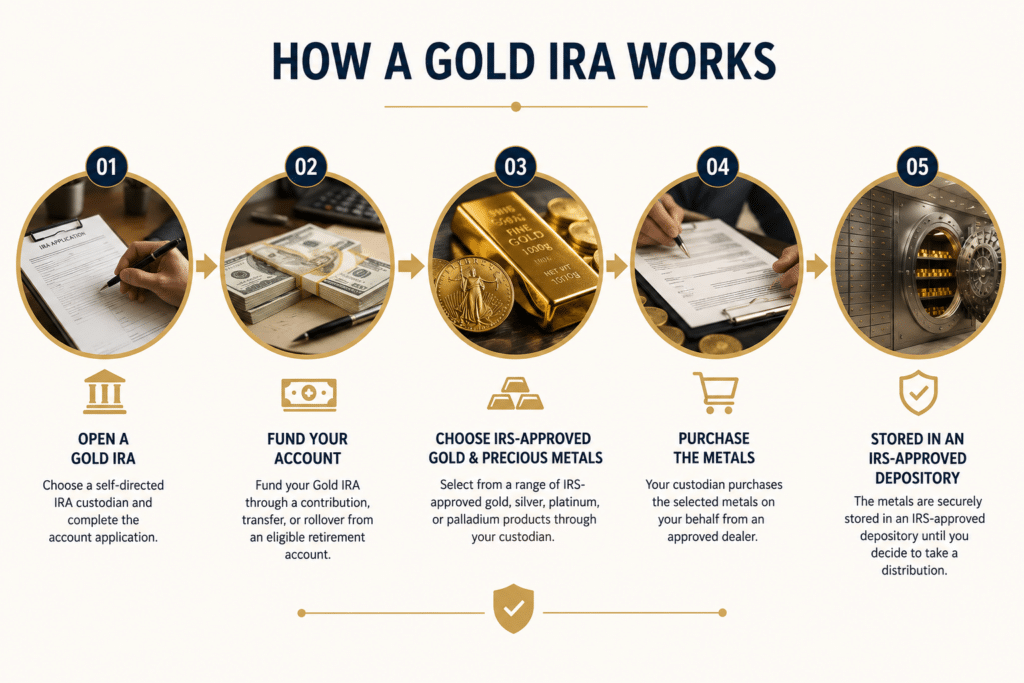
How Does a Gold IRA Work?
Opening a Gold IRA generally involves several steps:
- Open a self-directed IRA with an approved custodian.
- Fund the account through a contribution, transfer, or eligible rollover.
- Select IRS-approved precious metals.
- Purchase the metals through an authorized precious metals dealer.
- Store the metals in an IRS-approved depository.
Unlike personally owned gold, the metals held inside a Gold IRA generally cannot be stored at home while maintaining IRA compliance.
What Types of Metals Can Be Held in a Gold IRA?
The IRS permits certain precious metals that meet specific purity standards.
Depending on account eligibility, investors may hold approved:
- Gold bullion
- Silver bullion
- Platinum bullion
- Palladium bullion
Certain qualifying coins and bars may also be eligible if they satisfy IRS requirements for purity and eligibility.
Examples often include:
- American Gold Eagle
- American Silver Eagle
- Canadian Gold Maple Leaf
- Gold bars from approved refiners
- Silver bars meeting IRS standards
Not every collectible coin qualifies for inclusion in a Gold IRA. Eligibility depends on IRS rules regarding purity and acceptable products.
Benefits of a Gold IRA
Many investors choose a Gold IRA because it combines physical precious metals with retirement planning.
Potential benefits include:
Tax-Advantaged Retirement Savings
Depending on the type of IRA and individual circumstances, contributions or withdrawals may receive favorable tax treatment under applicable IRS rules.
Portfolio Diversification
Adding precious metals may help diversify retirement holdings by introducing an asset class that has historically behaved differently from many traditional investments.
Professional Storage
IRS-approved depositories provide secure storage and inventory management for eligible IRA metals.
Long-Term Wealth Preservation
Some investors view gold as a long-term store of value that may help preserve purchasing power over extended periods.
Eligible Rollovers and Transfers
Many retirement savers explore transferring or rolling over eligible retirement funds into a self-directed Gold IRA while following IRS regulations.
Important Considerations
Although Gold IRAs offer several potential advantages, investors should also understand their responsibilities.
These may include:
- Custodian fees
- Storage fees
- Administrative costs
- IRS regulations
- Required Minimum Distribution (RMD) rules for applicable accounts
- Limited direct access to stored metals while they remain inside the IRA
Understanding these factors helps investors determine whether a Gold IRA fits their overall retirement strategy.
What Is Physical Gold?
Physical gold refers to gold that you purchase directly and own personally outside of a retirement account.
Rather than holding paper assets that represent gold, physical ownership means possessing actual bullion products such as coins or bars.
Many investors appreciate physical ownership because it provides direct control over their assets without relying on a retirement account structure.
Common Types of Physical Gold
Physical gold is generally available in several forms.
Gold Coins
Government-issued bullion coins are among the most recognizable options.
Popular examples include:
- American Gold Eagle
- Canadian Gold Maple Leaf
- Austrian Gold Philharmonic
- South African Krugerrand
- American Gold Buffalo
Many investors choose coins because they are widely recognized and available in multiple sizes.
Gold bars are commonly available from accredited refiners in various weights.
Investors often choose bars because they may carry lower premiums per ounce compared to smaller bullion coins, although pricing varies by product, size, and market conditions.
Fractional Gold
Some investors prefer smaller denominations such as:
- 1/10 oz
- 1/4 oz
- 1/2 oz
These options may provide greater purchasing flexibility for individuals building their holdings gradually.
Where Can Physical Gold Be Stored?
Unlike Gold IRA assets, personally owned gold can generally be stored according to the owner’s preferences.
Common storage choices include:
Home Safe
Some investors prefer keeping gold at home in a high-quality safe.
This option provides immediate access but also places responsibility for security and insurance on the owner.
Bank Safe Deposit Box
Some individuals choose bank safe deposit boxes for additional security.
Availability, access policies, and insurance considerations vary by institution.
Private Vault Storage
Professional vault providers offer secure storage solutions with varying levels of insurance, auditing, and accessibility.
Many investors choose professional storage for larger holdings.
Advantages of Owning Physical Gold
Direct ownership offers several unique benefits.
Complete Personal Ownership
You control when to buy, sell, or transfer your gold without the structure of a retirement account.
Immediate Accessibility
Depending on where the gold is stored, owners may have direct access to their holdings.
No IRA Custodian Required
Physical ownership outside of an IRA generally does not require a retirement account custodian.
Flexible Purchasing
Investors can purchase coins or bars in a wide variety of sizes based on their budget and financial goals.
Is Physical Gold Right for Everyone?
Physical gold can be an attractive option for investors seeking tangible asset ownership. However, it also comes with responsibilities such as secure storage, insurance considerations, and understanding market pricing.

Gold IRA vs Physical Gold: Side-by-Side Comparison
Choosing between a Gold IRA and physical gold isn’t simply a matter of deciding how to buy gold—it’s about selecting the ownership structure that best supports your financial goals.
Both options provide exposure to physical precious metals, but they serve different purposes. A Gold IRA is generally designed for retirement savings with potential tax advantages, while personally owned physical gold offers direct ownership and greater accessibility.
Understanding the key differences can help you determine which option aligns with your investment strategy.
Quick Comparison Table
| Feature | Gold IRA | Physical Gold |
| Ownership | Held within a self-directed retirement account | Owned directly by the individual |
| Tax Treatment | May offer tax advantages depending on IRA type | Tax treatment depends on applicable laws and holding period |
| Storage | IRS-approved depository required | Home safe, private vault, or bank safe deposit box |
| Accessibility | Access generally occurs through IRA distribution rules | Immediate access if personally stored |
| Custodian Required | Yes | No |
| Storage Fees | Typically applicable | Depends on chosen storage method |
| Retirement Planning | Specifically designed for retirement savings | General wealth preservation and asset ownership |
| IRS Regulations | Must comply with IRS rules | No IRA-specific requirements |
| Eligible Metals | IRS-approved bullion and qualifying coins | Broad selection of bullion products and collectible items |
| Best For | Long-term retirement planning | Direct ownership and flexibility |
Understanding the Biggest Differences
Although both options involve owning gold, the way you own, manage, and eventually use the asset differs significantly.
Let’s examine each factor in greater detail.
1. Ownership Structure
One of the most significant differences is how ownership is established.
Gold IRA
When you invest through a Gold IRA, the precious metals are purchased within your retirement account and held by an approved custodian in an IRS-approved depository.
You remain the beneficial owner of the assets, but the metals must remain under the custody of the IRA until distributions are taken according to IRS regulations.
Physical Gold
With physical gold, you purchase the coins or bars directly.
You decide:
- Where to buy
- Where to store
- When to sell
- Whether to transfer ownership
There are no retirement account rules governing personally owned bullion.
Key Takeaway:
A Gold IRA emphasizes retirement investing within a regulated framework, while physical gold emphasizes direct ownership and personal control.
2. Tax Considerations
Taxes are often one of the primary reasons investors consider a Gold IRA.
Gold IRA
Depending on whether you establish a Traditional or Roth IRA—and your individual tax circumstances—you may benefit from tax-deferred growth or qualified tax-free withdrawals.
However, IRS contribution limits, distribution rules, and eligibility requirements apply.
Physical Gold
Personally owned gold does not receive the same retirement account tax treatment.
Any tax implications associated with buying or selling physical gold depend on applicable federal, state, and local tax laws, as well as factors such as holding period and transaction details.
Because tax situations vary, consulting a qualified tax professional is always recommended.
3. Storage Requirements
Storage is another major distinction.
Gold IRA Storage
IRS regulations generally require IRA-owned precious metals to be stored in an approved depository.
Professional storage provides:
- High-security facilities
- Inventory controls
- Insurance
- Independent auditing
- Regulatory compliance
Home storage generally does not satisfy IRS requirements for metals held within a Gold IRA.
Physical Gold Storage
Owners have greater flexibility.
Popular options include:
- Home safe
- Private vault
- Bank safe deposit box
Each choice involves different trade-offs involving convenience, security, insurance, and ongoing costs.
4. Accessibility
How quickly can you access your gold?
Gold IRA
Since the metals are part of a retirement account, distributions typically follow IRS rules and may have tax consequences depending on your age, account type, and circumstances.
Physical Gold
If stored personally, owners generally have immediate access whenever needed.
Many investors appreciate this flexibility because they maintain direct control over their assets.
5. Costs and Ongoing Fees
Every investment has associated costs.
Understanding them beforehand helps prevent surprises.
Typical Gold IRA Costs
Depending on the provider, investors may encounter:
- Account setup fees
- Annual custodian fees
- Storage fees
- Insurance fees
- Administrative charges
- Dealer premiums
These costs vary among custodians and precious metals dealers.
Typical Physical Gold Costs
Investors purchasing physical bullion may incur:
- Dealer premiums
- Shipping costs
- Insurance (if desired)
- Vault storage fees (if professionally stored)
There are generally no annual IRA administration fees because the metals are not held within a retirement account.
6. Retirement Planning Benefits
This is where a Gold IRA often stands apart.
A Gold IRA is specifically structured for retirement savings.
It allows eligible investors to incorporate IRS-approved precious metals into a long-term retirement strategy while remaining within a tax-advantaged retirement account.
Physical gold, on the other hand, serves as a personally owned asset outside of retirement accounts.
While it may contribute to long-term wealth preservation, it doesn’t automatically provide the retirement account features available through an IRA.
Gold IRA Advantages
Many retirement-focused investors appreciate several features unique to Gold IRAs.
Potential Tax Advantages
Depending on the account type and individual circumstances, investors may benefit from tax-deferred or tax-free growth.
Professional Storage
Approved depositories provide secure storage designed specifically for retirement assets.
Retirement Diversification
Adding precious metals can introduce an additional asset class to complement traditional retirement investments.
Long-Term Focus
Gold IRAs are generally intended for investors with long investment horizons rather than short-term trading objectives.
Regulatory Oversight
IRS guidelines establish standards regarding eligible metals, custodians, storage, and distributions.
Although these rules require compliance, they also create a structured framework for retirement investing.
Physical Gold Advantages
Direct ownership offers several benefits that appeal to many investors.
Complete Control
You decide when to purchase, store, sell, or gift your bullion.
Immediate Possession
Personally stored gold can generally be accessed whenever needed.
No Retirement Restrictions
Physical ownership does not involve IRA contribution limits or retirement account administration.
Flexible Purchasing
Investors can gradually build their holdings by purchasing different weights and products over time.
Potential Risks of a Gold IRA
Every investment strategy carries risks and considerations.
Before opening a Gold IRA, investors should understand factors such as:
- Annual maintenance costs
- Storage expenses
- Custodian fees
- IRS compliance requirements
- Rules governing distributions
- Market price fluctuations
Gold prices can rise and fall over time, and a Gold IRA should be viewed as one component of a diversified investment strategy rather than a guarantee of future performance.
Potential Risks of Physical Gold
Direct ownership also involves important considerations.
These may include:
- Theft risk if stored improperly
- Responsibility for secure storage
- Insurance costs
- Dealer premiums
- Market volatility
- Liquidity depending on product type and local demand
Proper storage and purchasing from reputable dealers can help reduce some of these risks.
Gold IRA vs Physical Gold During Inflation
One of the most common reasons investors purchase gold is the belief that it may help preserve purchasing power during periods of rising inflation.
Historically, gold has often been viewed as a store of value during times of economic uncertainty. However, gold prices have experienced both increases and declines over different market cycles, and past performance does not guarantee future results.
Whether you own gold through a Gold IRA or as physical bullion, both options provide exposure to the same underlying precious metal. The primary differences relate to ownership structure, taxation, storage, and retirement planning—not the intrinsic characteristics of gold itself.
Investors concerned about inflation often evaluate gold as part of a broader, diversified portfolio rather than relying on it as a single solution.
Which Option Is Better for Retirement?
There isn’t a universal answer because every investor has unique financial goals, timelines, and risk tolerance.
A Gold IRA May Be Appropriate If You:
- want to include precious metals in a retirement account.
- Are interested in potential tax advantages available through eligible IRAs.
- Prefer professional storage and administrative support.
- Have a long-term retirement investment horizon.
- want to diversify beyond traditional retirement assets.
Physical Gold May Be Appropriate If You:
- Prefer direct ownership of your bullion.
- Want flexibility outside of retirement account rules.
- Value immediate access to your assets.
- Are building a personal precious metals collection.
- Prefer to manage your own storage arrangements.
Many Investors Consider Both
Some individuals choose to combine a Gold IRA with personally owned physical gold.
This approach may provide:
- Retirement-focused savings through the IRA.
- Direct ownership outside retirement accounts.
- Greater flexibility.
- Additional portfolio diversification.
The appropriate allocation depends on personal financial objectives and should be discussed with qualified financial and tax professionals.
How to Decide Between a Gold IRA and Physical Gold
After understanding the similarities and differences, the next step is determining which option best fits your financial goals. There is no one-size-fits-all answer because every investor has different priorities, timelines, and comfort levels with risk.
Rather than asking, “Which option is better?”, consider asking:
- What am I investing for?
- When might I need access to my money?
- Am I planning primarily for retirement?
- Do I prefer direct ownership or a professionally managed retirement account?
- How does gold fit into my overall investment strategy?
Answering these questions can help clarify whether a Gold IRA, physical gold, or a combination of both is appropriate for your situation.
Who Should Consider a Gold IRA?
A Gold IRA may be a suitable option for individuals who:
- Are focused on long-term retirement planning.
- Want to diversify a retirement portfolio beyond traditional assets.
- Are interested in holding IRS-approved precious metals within a retirement account.
- Prefer secure, professional storage through an approved depository.
- Are comfortable following IRS regulations governing retirement accounts.
Because a Gold IRA is designed specifically for retirement investing, it may appeal to investors who do not expect to access these assets in the near future.
Who May Prefer Physical Gold?
Physical gold may be appropriate for investors who:
- Value direct ownership of tangible assets.
- Want flexibility outside retirement account rules.
- Prefer deciding where and how their gold is stored.
- Appreciate having immediate access to their holdings.
- Wish to purchase bullion gradually over time.
Personally owned gold may also complement other investments by providing an additional form of diversification.
Can You Own Both?
Absolutely.
Many experienced investors choose not to view this decision as an “either-or” choice.
Instead, they may combine:
- A Gold IRA for retirement savings.
- Personally owned gold for direct access and flexibility.
This approach allows investors to benefit from the unique features of each ownership method while maintaining a diversified financial strategy.
The appropriate balance depends on individual objectives, retirement plans, liquidity needs, and overall portfolio allocation.
Common Mistakes Investors Should Avoid
Whether purchasing physical gold or opening a Gold IRA, avoiding common mistakes can help investors make more informed decisions.
1. Investing Without a Long-Term Plan
Gold is often viewed as a long-term asset rather than a short-term trading vehicle.
Before investing, define your objectives, timeline, and how precious metals fit into your broader financial strategy.
2. Ignoring Portfolio Diversification
Even though gold has historically been valued as a store of wealth, concentrating too much of a portfolio in a single asset class can increase overall risk.
A diversified portfolio typically includes multiple types of investments based on personal financial goals and risk tolerance.
3. Not Understanding Fees
Gold IRAs may include:
- Custodian fees
- Storage fees
- Administrative costs
Physical gold may involve:
- Dealer premiums
- Shipping charges
- Storage expenses
- Insurance costs
Understanding these costs before investing helps set realistic expectations.
4. Buying From Unverified Sources
When purchasing precious metals, working with established dealers can help improve confidence in product authenticity and transparency.
Look for businesses that clearly explain:
- Product specifications
- Pricing
- Shipping policies
- Buyback options
- Customer support
5. Choosing Products Without Understanding Eligibility
Not every coin or bar qualifies for inclusion in a Gold IRA.
If investing through an IRA, verify that metals meet applicable IRS eligibility requirements before making a purchase.
6. Making Emotional Decisions
Economic headlines can sometimes encourage investors to make quick decisions.
Instead of reacting emotionally to market movements, consider reviewing your investment strategy periodically and making decisions based on long-term goals.
Expert Tips for First-Time Gold Investors
If you’re new to precious metals, these practical guidelines can help you get started thoughtfully.
Start With Clear Goals
Determine whether you’re investing primarily for:
- Retirement
- Wealth preservation
- Portfolio diversification
- Long-term asset ownership
Your objectives should guide the type of gold investment you choose.
Learn the Different Product Types
Gold investments can include:
- Bullion coins
- Gold bars
- Fractional gold
- Precious metals held within a Gold IRA
Understanding these options makes comparing products much easier.
Research Storage Options
Secure storage is an important consideration regardless of how you own gold.
Evaluate security, accessibility, insurance, and long-term costs before deciding where your assets will be stored.
Stay Informed
Gold prices respond to a variety of economic factors, including inflation, interest rates, currency movements, and global events.
Staying informed can help you better understand market conditions without relying solely on short-term price changes.
Work With Trusted Professionals
When considering retirement accounts or significant purchases, many investors find value in speaking with qualified financial advisors, tax professionals, and reputable precious metals specialists before making major decisions.
Frequently Asked Questions
Is a Gold IRA better than buying physical gold?
Neither option is universally better. A Gold IRA is designed for retirement savings and may offer tax advantages depending on the account type and individual circumstances. Physical gold provides direct ownership and greater flexibility outside of retirement accounts.
Can I own both a Gold IRA and physical gold?
Yes. Many investors choose to hold precious metals in both forms. A Gold IRA can support retirement planning, while personally owned gold offers direct access and personal ownership.
Can I store Gold IRA metals at home?
Generally, IRS rules require precious metals held within a Gold IRA to be stored in an approved depository. Personally owned gold purchased outside an IRA may be stored according to the owner’s preference.
What types of gold qualify for a Gold IRA?
Only certain IRS-approved gold products that meet required purity standards are generally eligible. Not all collectible or rare coins qualify for inclusion in a Gold IRA.
Does physical gold require insurance?
Insurance is typically optional for personally owned gold, but many investors choose to insure valuable holdings depending on where they are stored.
Is physical gold easy to sell?
Gold bullion is generally considered a liquid asset, although the ease of selling may depend on the product type, market conditions, and the dealer or buyer involved.
Can I transfer an existing retirement account into a Gold IRA?
Many investors explore eligible transfers or rollovers from certain retirement accounts into a self-directed Gold IRA. Eligibility and procedures vary, so it is important to consult your IRA custodian and financial advisor before initiating a rollover.
Is gold guaranteed to increase in value?
No. Like all investments, gold prices fluctuate based on market conditions. While many investors consider gold a long-term store of value, past performance does not guarantee future results.
How much gold should be part of my portfolio?
There is no universal allocation that fits every investor. The appropriate amount depends on your financial objectives, investment timeline, overall portfolio composition, and risk tolerance.
Should beginners buy physical gold or open a Gold IRA?
The answer depends on individual goals. Investors focused primarily on retirement may explore whether a Gold IRA aligns with their long-term strategy, while those seeking direct ownership may prefer purchasing physical bullion. Consulting qualified financial and tax professionals can help determine the most appropriate approach.
Why Education Matters Before Investing
One of the most valuable investments you can make is investing in your understanding.
Gold has been trusted for centuries, but deciding how to own it requires careful consideration of factors such as taxes, storage, retirement planning, liquidity, and personal financial objectives.
Taking the time to learn about these topics can help you make more informed decisions and avoid common pitfalls.
Whether you’re evaluating a Gold IRA, purchasing physical bullion, or comparing both options, an informed approach is more likely to support your long-term financial goals.