Who Can Open an IRA? Eligibility Rules, 401(k) Basics, and Precious Metals IRA
Saving for retirement is one of the most important financial decisions you’ll make. Whether you’re just starting your career, running a business, self-employed, or approaching retirement age, understanding who can open an IRA can help you build a stronger financial future.
Many investors also want to know what is an IRA, what is a 401(k), what is a 401(k) plan, and what is a 401(k) and how does it work? In this guide, we’ll answer these questions while exploring IRA eligibility, contribution rules, and how retirement savers can potentially diversify through a Gold IRA, Silver IRA, or Self-Directed IRA.
Who Can Open an IRA?
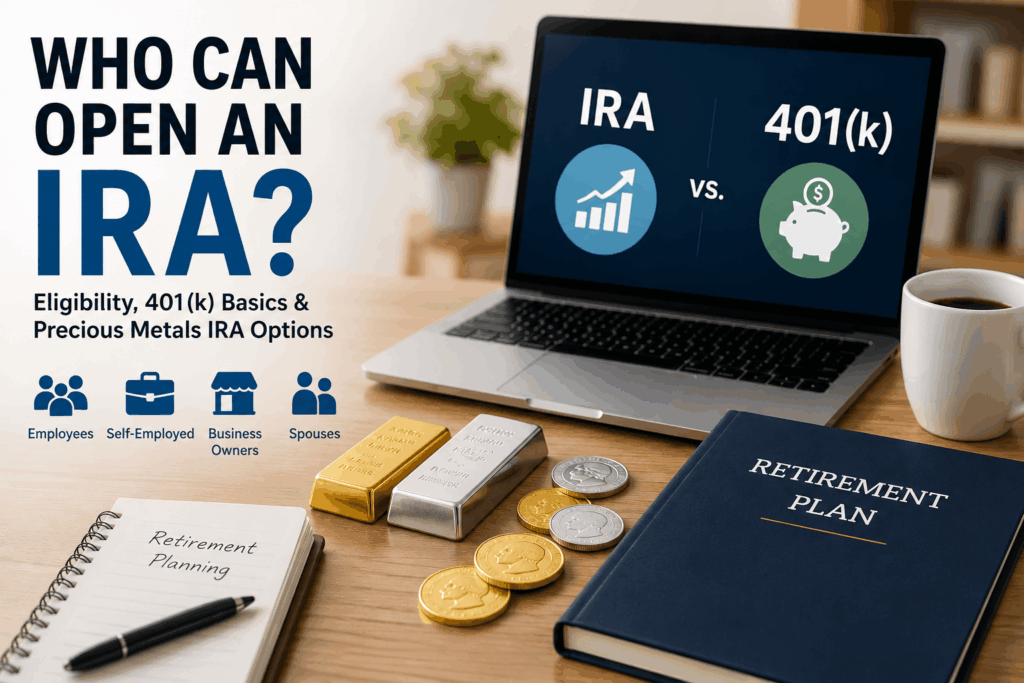
Most individuals with earned income can open an IRA, including employees, self-employed workers, freelancers, business owners, and eligible spouses.
According to IRS guidelines, individuals who receive taxable compensation may generally contribute to an IRA, subject to annual contribution limits and eligibility requirements. Taxable compensation typically includes wages, salaries, commissions, self-employment income, bonuses, and other forms of earned income.
Individuals Who Can Typically Open an IRA
- Full-time employees
- Part-time employees
- Self-employed individuals
- Freelancers and independent contractors
- Small business owners
- Gig economy workers
- Eligible non-working spouses (through a Spousal IRA)
- Individuals changing jobs
- Investors rolling over retirement funds
The ability to contribute may depend on factors such as income, filing status, age, and the type of IRA being opened.
What Is an IRA?
An Individual Retirement Account (IRA) is a tax-advantaged retirement savings account designed to help individuals save and invest for retirement.
IRAs offer potential tax benefits and long-term growth opportunities that can help individuals build wealth over time. Depending on the IRA type, contributions may be tax-deductible or qualified withdrawals may be tax-free.
Common IRA options include:
- Traditional IRA
- Roth IRA
- SEP IRA
- SIMPLE IRA
- Self-Directed IRA
- Precious Metals IRA
Each account type serves different retirement planning needs and financial goals.
Who Is Eligible to Open an IRA?
While many people qualify, eligibility often depends on earned income and IRS requirements.
Can Students Open an IRA?
Yes. Students can open an IRA if they have earned income from a job, internship, freelance work, or self-employment activities.
Starting an IRA at a young age can provide decades of potential compound growth.
Can Self-Employed Individuals Open an IRA?
Absolutely.
Self-employed professionals often use:
- Traditional IRAs
- Roth IRAs
- SEP IRAs
- Self-Directed IRAs
Business owners and freelancers frequently use retirement accounts to build long-term savings while potentially reducing current taxable income.
Can Small Business Owners Open an IRA?
Yes.
Small business owners may establish:
- Traditional IRAs
- SEP IRAs
- SIMPLE IRAs
- Self-Directed IRAs
These accounts can provide retirement benefits for both owners and employees.
Can a Non-Working Spouse Open an IRA?
Yes.
A Spousal IRA may allow a non-working spouse to contribute to an IRA if the working spouse has sufficient earned income and IRS requirements are met.
Can Retired Individuals Open an IRA?
Retirees can generally open an IRA if they have qualifying earned income.
However, retirement benefits such as Social Security income alone do not typically count as earned income for IRA contribution purposes.
Can Minors Open an IRA?
Yes.
Minors with earned income may open a custodial IRA, typically managed by a parent or guardian until the child reaches legal adulthood.
Age Limits for Opening an IRA
One common question is whether age restrictions apply.
Historically, Traditional IRAs had age-based contribution limitations. However, current IRS rules generally allow eligible individuals with earned income to contribute regardless of age.
This means many older workers can continue contributing to retirement accounts if they meet income requirements.
What Are the IRA Contribution Limits?
The IRS establishes annual IRA contribution limits that may change periodically.
Contribution limits vary based on:
- Age
- Filing status
- Income level
- IRA type
Because these limits can change from year to year, investors should review the latest IRS guidelines or consult a qualified financial professional before making contributions.
Can You Open an IRA If You Already Have a 401(k)?
Yes.
Many people mistakenly assume they must choose between an IRA and a workplace retirement plan.
In reality, you can often contribute to both an IRA and a 401(k). However, income limits and tax deduction rules may affect eligibility depending on your circumstances.
Using both accounts may help maximize retirement savings while providing additional tax advantages.
What Is a 401(k)?
A 401(k) is an employer-sponsored retirement savings account that allows employees to contribute a portion of their earnings toward retirement investments.
Contributions are generally made through automatic payroll deductions, making retirement saving convenient and consistent.
Many employers also offer matching contributions, which can significantly increase retirement savings over time.
What Is a 401(k) Plan?
A common question among employees is: What is a 401(k) plan?
A 401(k) plan is a qualified retirement program established by an employer that enables workers to save and invest for retirement while receiving certain tax advantages.
Investment options commonly include:
- Mutual funds
- Index funds
- Target-date funds
- Bond funds
- Employer stock (when available)
The specific investment choices vary by plan provider.
What Is a 401(k) and How Does It Work?
Understanding what is a 401(k) and how does it work is important for retirement planning.
Here’s a simplified breakdown:
Step 1: Enroll in the Plan
Employees enroll through their employer’s retirement benefits program.
Step 2: Choose a Contribution Amount
A percentage of each paycheck is directed into the account.
Step 3: Investments Are Selected
Contributions are invested in available plan options.
Step 4: Employer Match May Apply
Some employers contribute matching funds based on employee contributions.
Step 5: Long-Term Growth
Investments have the opportunity to grow over time through market appreciation and compounding returns.
IRA vs. 401(k): Which Is Better?
The answer depends on your goals.
| Feature | IRA | 401(k) |
| Opened By | Individual | Employer |
| Investment Flexibility | High | Limited to Plan Options |
| Employer Match | No | Often Available |
| Account Control | Full Control | Employer Plan Rules |
| Alternative Assets | Available Through Self-Directed IRA | Typically Not Available |
Many retirement savers choose to use both accounts when eligible.
Can You Open a Precious Metals IRA?
Yes.
Investors interested in portfolio diversification often ask whether they can hold physical precious metals within a retirement account.
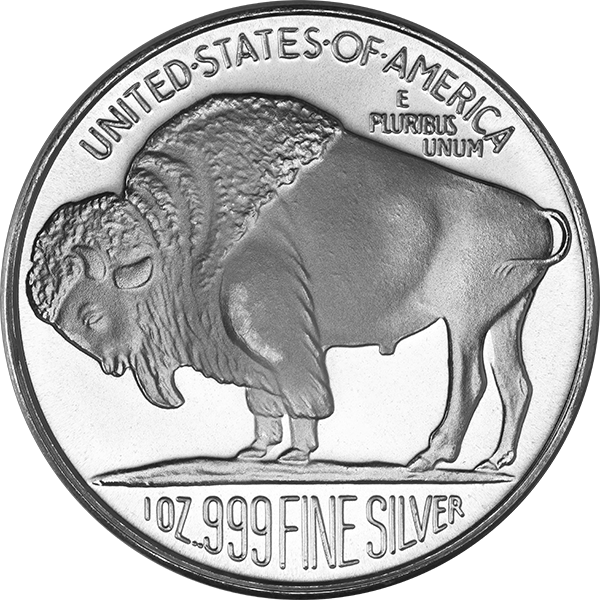
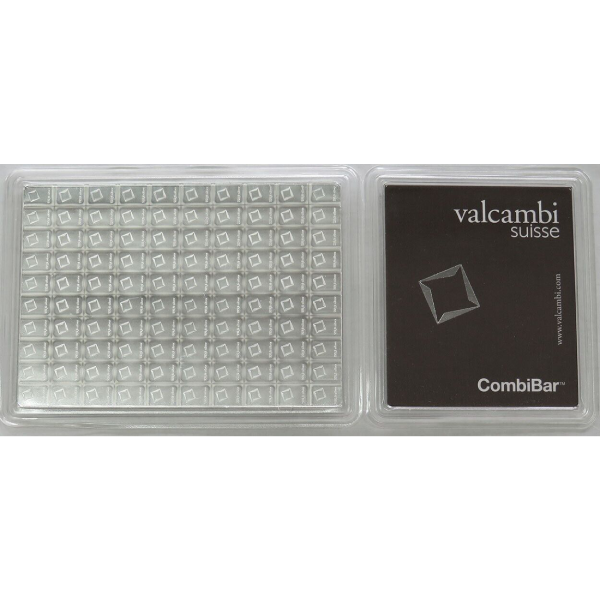
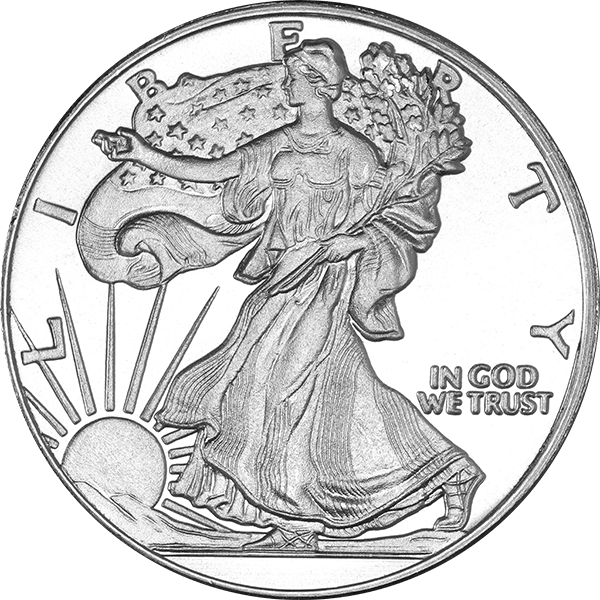
A Precious Metals IRA is a specialized form of Self-Directed IRA that may allow eligible precious metals investments, subject to IRS requirements.
These accounts may include:
- Gold IRA investments
- Silver IRA investments
- Platinum IRA investments
- Palladium IRA investments
However, only specific IRS-approved precious metals are generally permitted.
Can You Open a Gold IRA?
A Gold IRA is typically available to eligible individuals who qualify to open a Self-Directed IRA.
Common funding methods include:
- New IRA contributions
- Traditional IRA transfers
- IRA rollovers
- 401(k) rollovers
Many investors choose Gold IRAs as part of a long-term diversification strategy.
Can You Open a Silver IRA?
Yes.
A Silver IRA operates similarly to a Gold IRA but focuses on IRS-approved silver products held within a Self-Directed IRA structure.
Silver can offer another option for investors seeking exposure to physical precious metals within retirement accounts.
What Is a Self-Directed IRA?
A Self-Directed IRA is a retirement account that provides access to a broader range of investment options than many traditional retirement plans.
Depending on custodian and IRS regulations, eligible investments may include:
- Precious metals
- Real estate
- Private placements
- Certain alternative assets
This flexibility makes Self-Directed IRAs attractive to investors seeking greater control over retirement portfolios.
Can You Roll Over a 401(k) Into a Precious Metals IRA?
In many cases, yes.
Individuals changing jobs, retiring, or leaving an employer may have the option to roll eligible retirement funds into a Self-Directed Precious Metals IRA.
The general process involves:
- Opening a Self-Directed IRA
- Initiating a rollover or transfer
- Funding the account
- Selecting eligible precious metals
- Storing assets through an approved depository
Investors should consult qualified financial and tax professionals regarding rollover eligibility and tax implications.
Benefits of Opening an IRA
Opening an IRA may provide several advantages:
Tax Benefits
Potential tax-deferred or tax-free growth depending on account type.
Investment Flexibility
Access to a wide range of investment options.
Retirement Security
Dedicated retirement savings with long-term growth potential.
Portfolio Diversification
Self-Directed IRAs can expand investment choices beyond traditional assets.
Greater Control
Investors maintain direct ownership and oversight of their retirement strategy.
In addition to learning what is an IRA, what is a 401(k), what is a 401(k) plan, and what is a 401(k) and how it works, investors should consider how diversification fits into their overall retirement goals. For those seeking broader investment flexibility, options such as a Gold IRA, Silver IRA, Self-Directed IRA, or Precious Metals IRA may provide additional opportunities to build a well-rounded retirement portfolio.
Frequently Asked Questions
- Who can open an IRA?
Most individuals with earned income can open an IRA, including employees, self-employed workers, freelancers, business owners, and eligible spouses.
- Can a retired person open an IRA?
Yes, provided they have qualifying earned income and meet applicable IRS requirements.
- Can a student open an IRA?
Yes. Students with earned income may open and contribute to an IRA.
- Can I have both an IRA and a 401(k)?
Yes. Many individuals contribute to both accounts to maximize retirement savings.
- What is an IRA?
An Individual Retirement Account (IRA) is a tax-advantaged retirement savings account designed to help individuals save and invest for retirement.
- What is a 401(k) plan?
A 401(k) plan is a workplace retirement program that allows employees to save and invest money for retirement with tax advantages.
- What is a 401(k) and how does it work?
A 401(k) works by allowing employees to contribute a portion of their paycheck into retirement investments, often with the possibility of employer matching contributions.